Israeli troops push deeper into Lebanon as the two sides start military talks at the Pentagon

BEIRUT (AP) — Israeli troops entered a southern Lebanese village early Friday, pushing deeper into the country as Lebanese and Israeli military officials began direct talks at the Pentagon over the deadly conflict.
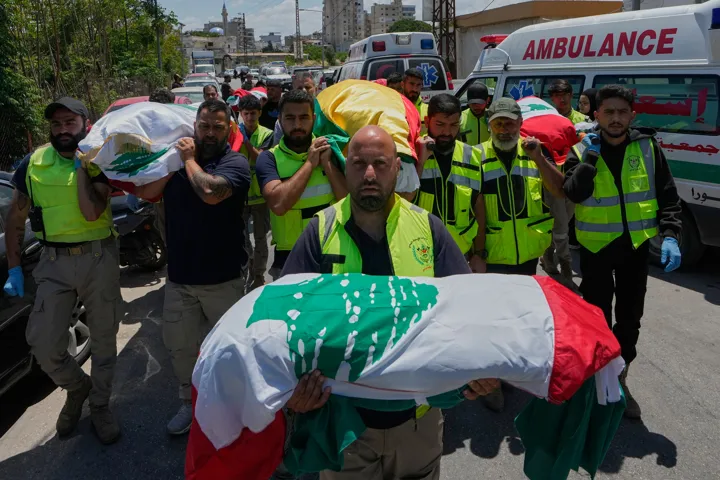
The entrance of Israel’s troops into the village of Dibbine, near the town of Marjayoun, came as Israeli airstrikes killed at least six people. Five were killed in an airstrike on the villages of Deir Qanoun al Nahr and Abbasiyeh, while a municipal policeman was killed in the village of Ebba, state media reported.
In Washington, a six-member Lebanese military delegation was meeting on Friday with Israeli military officials in the first direct military talks between the two countries in decades.
A nominal ceasefire went into effect on April 17. A senior Lebanese military official told The Associated Press Friday that the Lebanese delegation, led by the army's head of operations Brig. Gen. George Rizkallah, would be to make it comprehensive.
The official added the Lebanese delegation will request the reactivation of the committee monitoring the enforcement of an earlier U.S.-brokered ceasefire that halted the war between Israel and Hezbollah in late 2024.
Another Lebanese official, who is briefed throughout the day about the ongoing talks at the Pentagon, also said the delegation would seek the comprehensive implementation of the ceasefire and a stop to ongoing hostilities.
He said implementation would be followed by talks at a later date on matters such as deploying the Lebanese army along the border and the withdrawal of Israeli troops from southern Lebanon.
Both officials spoke on condition of anonymity because they were not authorized to speak to the media about the ongoing talks in Washington.
President Joseph Aoun's office said he received a call Friday from U.S. Secretary of State Marco Rubio and they discussed the situation in Lebanon and the latest developments in the Middle East. Aoun's office said the president told Rubio that efforts should concentrate on implementing the ceasefire as it is “the essential entry point for transitioning to any other issues.”
In April, Lebanon and Israel held the first direct talks in Washington in more than three decades.
The Israeli military issued several evacuation warnings for southern Lebanon on Friday, forcing hundreds of families to flee to safer areas further north.
Israeli troops fought Hezbollah fighters inside the villages of Yohmor and Zawtar al-Sahrqieh near the city of Nabatieh after they crossed the strategic Litani River, which the Israeli military has used as a de facto boundary. Large areas to the south are under Israeli military control, despite the April ceasefire.
Hezbollah, whose members have been fighting Israeli troops for days in the area, said in statements that its members struck Israeli troops inside Yohmor.
The two villages are close to the Crusader-built Beaufort castle that is about 15 kilometers (9 miles) from the Israeli border and overlooks wide parts of southern Lebanon. It was not clear if Israeli troops are trying to capture the castle, which lies north of the Litani.
Israel's Prime Minister Benjamin Netanyahu visited the northern front Friday where he spoke to members of the military. “I must tell you that there are very impressive results here. Our forces have crossed the Litani; they have advanced to controlling positions,” he said.
“We are operating in Beirut, in the Bekaa, across the entire width of the front, and we are dealing Hezbollah a crushing blow,” Netanyahu said referring to Lebanon's eastern Bekaa Valley and Beirut's southern suburbs where Israel's air force struck on Thursday.
The violence in southern Lebanon came as U.S. and Iranian negotiators reached a tentative agreement Thursday to extend the ceasefire in the 3-month-old war by 60 days and start a new round of talks on Iran’s nuclear program, according to a U.S. official familiar with the matter.
Iran did not immediately confirm any deal. Vice President JD Vance on Thursday evening confirmed there was a tentative agreement, but said it was unclear if President Donald Trump would approve it.
Hezbollah legislator Hassan Fadlallah said Friday that any deal between Iran and the U.S. would stop Israel’s offensive in Lebanon. Officials in Iran, Hezbollah’s main backer, have said that they insist that a deal with Washington would stop the latest Israel-Hezbollah war that started on March 2, when Hezbollah fired rockets into northern Israel two days after Israel and Iran attacked in Iran.
The latest Israel-Hezbollah war has left 3,200 people dead in Lebanon and over 1 million people displaced.
___
Associated Press writer Kareem Chehayeb contributed to this report from Beirut.