Former NYPD pilot reveals unseen aerial photos of 9/11 | Exclusive

Twenty-five years after 9/11, Greg Semendinger's aerial photos still transport him back to that fateful day.
Semendinger, a detective and helicopter pilot for the New York City police, had been dispatched
to the World Trade Center right after the first plane attack that morning in 2001. As his chopper approached, he could see the giant gash where an airliner had sliced through seven floors near the top of the north tower and black smoke was billowing out.
Semendinger wasn't an official photographer for the NYPD, but he always carried a camera to document his squad's rescues and had one in the chopper that morning as an unthinkable horror unfolded before him.
He grabbed it and started snapping away.
The images he captured over the next 90 minutes were astonishing, among the only aerial photos of the twin towers as they burned and then collapsed, one after the other. With his co-pilot at the controls and hovering above, Semendinger trained his lens as the second tower vaporized in a plunging cascade of debris, and an immense grey cloud mushroomed across Lower Manhattan.
Some of the photos he took 25 years ago have emerged into public view in various ways: appropriated by other people for their books; displayed in news articles in 2010; mounted in the 9/11 museum at Ground Zero with his permission. But many have remained unseen until recently, when he shared his trove with the USA TODAY Network for 9/11 anniversary coverage.
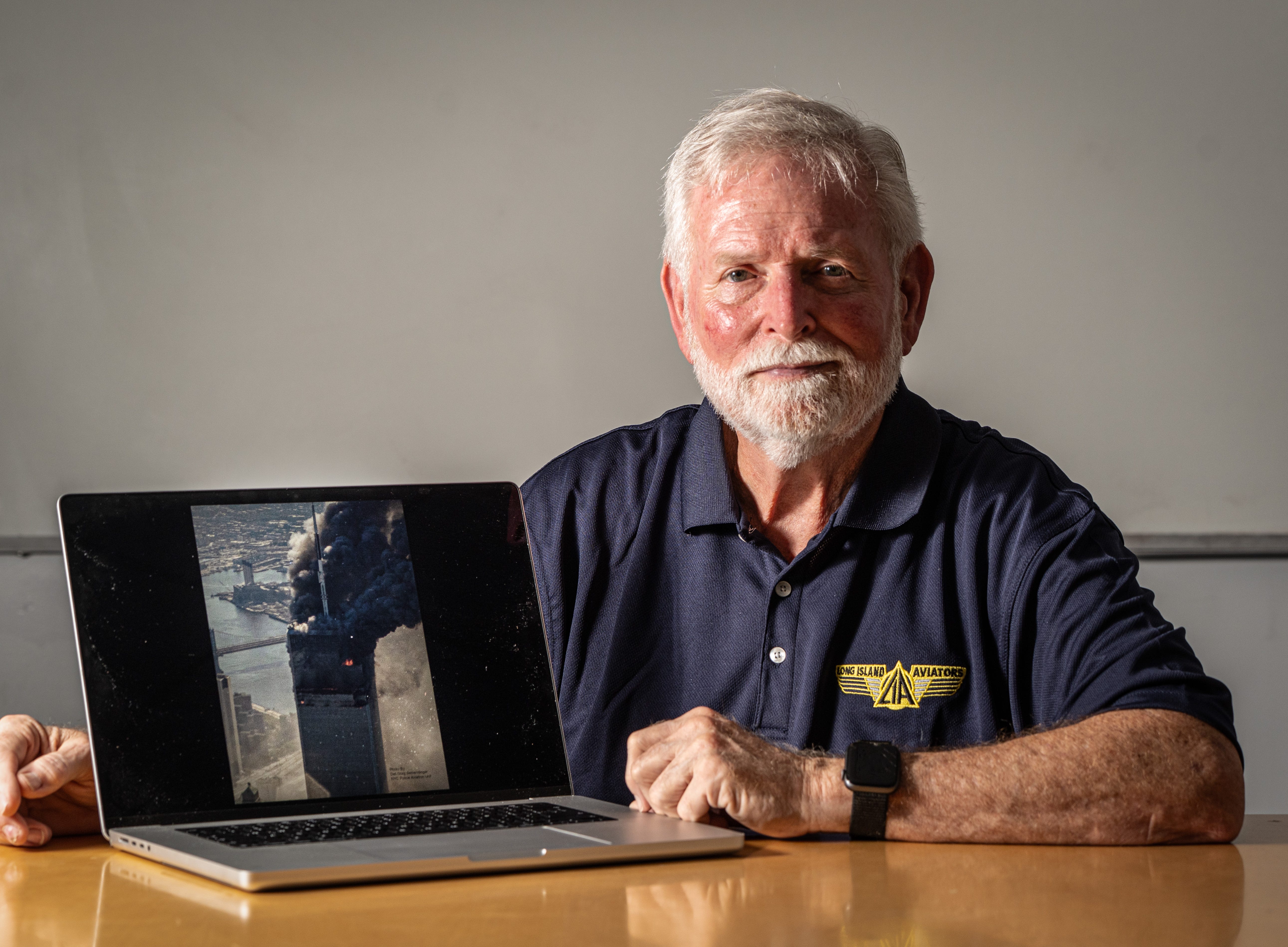
Semendinger, now 77 and retired from the NYPD Aviation Unit since 2002, toggled through those stunning images on his laptop one August afternoon at the Long Island airport where he works. He recounted his fateful flight as he clicked from one photo to the next, the horrific scenes he witnessed and preserved for history.
“This was taken right after the second plane hit," he said as he lingered on an image and thought back to that moment. "We saw the initial explosion, the explosion went away. But the papers that were blown out of the building was unbelievable. The compression from the second plane hitting was just tremendous.”
Sent to check on a suspected mishap
Semendinger was already at work that morning when the first startling reports came in.
It was 8:46 a.m. on Sept. 11, 2001. A plane had crashed into one of the towers, in what people first thought was an accident involving a small private aircraft. Because how else could a plane fly into the paired peaks of the Manhattan skyline on a clear day?
Semendiger, who was readying police helicopters for that day's flights at Floyd Bennett Field in Brooklyn, stepped outside the hangar and gazed toward the tip of Manhattan. The late summer sky was azure blue, absolutely cloudless, offering a clear view of the tops of the nearly 1,400-foot-tall buildings.
"I look at the towers and I see the amount of smoke coming from it," Semendinger recalled in the recent interview. "And I said, ‘that does not look like a small plane.’”
It was, in fact, a Boeing 767, an American Airlines jet with 92 people aboard that five terrorists had hijacked and flown into the north tower, striking it between the 93rd and 99th floors. Semendinger soon had a close view of the damage. He and his partner, Jim Ciccone, raced over Brooklyn in their helicopter and got to the scene 8 minutes after the impact.
They flew an L-shaped pattern around the burning tower to see if any people emerged on the roof, where a larger chopper might scoop them up. No one came out. (A rooftop rescue may have been impossible anyway, since landing there was ruled out as too dangerous.)
Then the second plane hit at 9:03 a.m. His view blocked by the buildings, Semendinger hadn't seen it speeding north over Staten Island before slamming into the south tower. He didn't even hear the crash over the noise of the helicopter and the radio noise on his headphones. But the sight of the explosion was unmistakable and he realized then what was happening.
“Well, now we know it’s terrorist attack," Semendinger recalled. "And now we know that there are other planes that are a possibility of being in the area.”
Watching the towers collapse
With the second tower now burning, too, Semendinger and Ciccone were summoned away from the scene to pick up a commanding officer in the Bronx. They had delivered him to Floyd Bennett Field and were returning to the towers when the next stage of the day's horror took place.
They were crossing over Brooklyn's Prospect Park when the south tower came down, at 9:59 a.m.
Semendinger captured that first collapse from a distance, now using a Canon digital camera instead of his film camera. He had grabbed his latest gear while their helicopter was refueling at Floyd Bennett Field. In those early years of advancing digital photography, it was one of the first cameras with built-in image stabilization.
“That’s why the pictures came out so good," Semendinger recalled. "Because when you’re bouncing around in a helicopter, stabilization was very important.”
As they flew near the burning north tower, Semendinger could see one edge buckling, an ominous sign after what had just happened. He got on the police radio to deliver a warning that was later quoted in the book "102 Minutes," a Sept. 11 account by Jim Dwyer and Kevin Flynn.
"I don't think this has too much longer to go," Semendinger said in their account, taken from a recording of the radio transmission. "I would evacuate all of the people within the area of that second building."
Recalling that moment years later, Semendinger said, "We knew the writing was on the wall." He pointed out a detail in the photos that he took at that time: scattered streams of smoke pouring from spots between the vertical steel columns that framed the tower.
Places where people had broken windows to breathe and signal for help. Or climb outside.
“All those gaps in the channels are people," he said. "They're people waving sheets and flags and stuff like that. Whatever they had, tablecloths. Those are all people.”
Those were his final, wrenching images of the north tower before its collapse. It fell at 10:28 a.m.
That awful moment and its aftermath are vividly frozen in time in Semendinger's digital archive, totaling about 150 images. They are grim scenes, laid out in full from the air. Lower Manhattan engulfed in smoke and debris. The bustling financial district shrouded in dust, looking like the soot-covered ruins of Pompeii.
Semendinger retired a year later, having served 18 years in the Aviation Unit and 35 years in all with the NYPD. By that time, several of his images had been spirited into a trio of books, including memoirs by the commissioners who led New York City's police and fire departments on Sept. 11.
Chris McKenna covers government and politics for The Journal News and USA TODAY Network. Reach him at CMcKenna@usatodayco.com.
.oembed-frame { width: 100%; height: 100%; margin: 0; border: 0; }
!function(e,n,i,s){var d="InfogramEmbeds";var o=e.getElementsByTagName(n)[0];if(window[d]&&window[d].initialized)window[d].process&&window[d].process();else if(!e.getElementById(i)){var r=e.createElement(n);r.async=1,r.id=i,r.src=s,o.parentNode.insertBefore(r,o)}}(document,"script","infogram-async","https://e.infogram.com/js/dist/embed-loader-min.js");