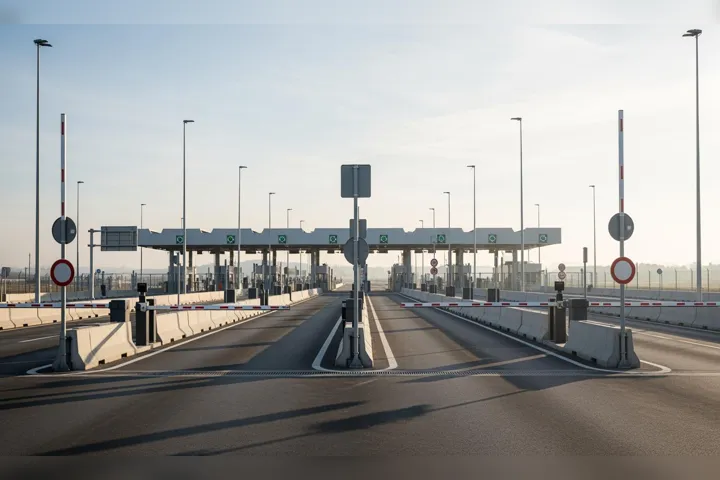
Rafah Border Crossing Reopens Amid Restrictions and Delays for Gaza Residents

What's Happening?
The Rafah border crossing between Gaza and Egypt has reopened after a two-day closure, marking a significant development in the region. This reopening is part of a fragile ceasefire deal following two years of conflict. However, the process has been marred by disagreements over who is allowed to cross, long delays, and reports of mistreatment by Israeli soldiers. Currently, only 50 people are permitted to return to Gaza each day, and 50 medical patients, along with two companions each, are allowed to leave. Despite these arrangements, fewer people than expected have crossed, with only 36 medical patients and 62 companions leaving for Egypt in the initial days. The crossing is a critical link for Gaza, providing the only access to the outside world not controlled by Israel.
Why It's Important?
The reopening of the Rafah crossing is crucial for the residents of Gaza, who have been isolated due to the ongoing conflict. It offers a potential lifeline for those seeking medical treatment unavailable in Gaza, where nearly 20,000 people are reportedly in need of such care. The restrictions and delays, however, highlight the ongoing challenges faced by Palestinians in accessing essential services and reuniting with family members. The situation underscores the broader geopolitical tensions in the region, involving Israeli, Egyptian, Palestinian, and international stakeholders. The limited movement through the crossing reflects the complex negotiations and security concerns that continue to impact the daily lives of Gaza's residents.
What's Next?
The initial phase of the Rafah crossing's reopening is considered a pilot, with the potential for increased movement if successful. However, challenges such as logistical delays, security screenings, and disagreements over crossing protocols need to be addressed. The international community, including the United Nations, is monitoring the situation, with human rights officials noting patterns of mistreatment by Israeli forces. Future developments will depend on the ability of involved parties to negotiate more efficient and humane crossing procedures, which could significantly impact the humanitarian situation in Gaza.
Beyond the Headlines
The reopening of the Rafah crossing has deeper implications for the region's stability and humanitarian conditions. The reports of mistreatment and the stringent restrictions highlight ongoing human rights concerns. The crossing's operation is a test of the ceasefire's durability and the willingness of involved parties to cooperate on humanitarian grounds. Long-term, the situation at Rafah could influence broader peace efforts and the international community's engagement in the Israeli-Palestinian conflict.
AI Generated Content
For the benefit of users - Parts of this article may include content generated using AI tools. Our teams are making active and commercially reasonable efforts to moderate all AI generated content. Our moderation processes are improving however our processes are carried out on a best-effort basis and may not be exhaustive in nature. We encourage our users to consume the content judiciously and rely on their own research for accuracy of facts. We maintain that all AI generated content on our platform is for entertainment purposes only. To know more about how we use AI, you can write to us at
Close AI Generated Content