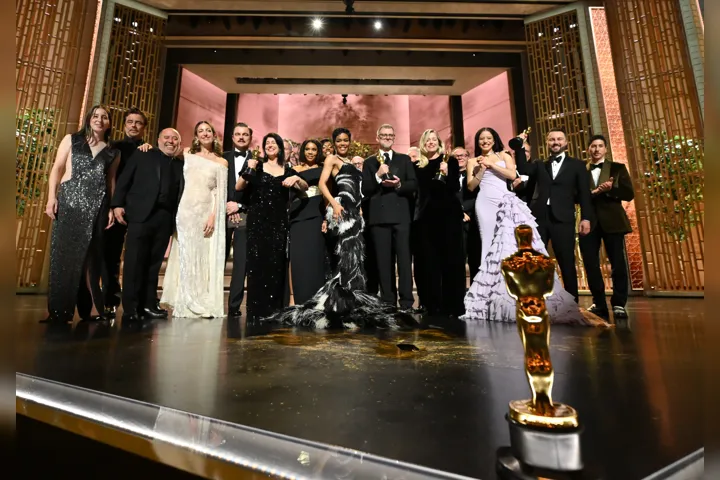
Why ‘One Battle After Another’ held off a ‘Sinners’ surge to win Best Picture


Click here to read the full article.
In the end, the stats triumphed over the vibes. Paul Thomas Anderson's One Battle After Another survived its time in the awards season battlefield and emerged as the big winner of the 98th Academy Awards, taking home six Oscars, including Best Adapted Screenplay, Best Director and Best Picture — the first PTA joint to hit that trifecta after years of near-misses with the likes of There Will Be Blood, Phantom Thread, and Licorice Pizza.
One Battle's victory followed a hard-fought bout with Ryan Coogler's Sinners, which saw a surge in enthusiasm in the closing days of the Oscar race. The vampire yarn ended up with four statuettes from its record-setting 16 nominations, including Best Actor for Michael B. Jordan, Best Original Screenplay for Coogler and a historic Best Cinematography win for Autumn Durald Arkapaw.
But really the big winner of the night was Warner Bros., which released both films and dominated the studio scorecard with 11 wins. It's a victory lap for a legacy Hollywood studio that's likely going to look very different at this time next year should its acquisition by Paramount Skydance meet regulatory approval.
Here's Gold Derby's post-mortem takes on some of the night's biggest races, including that Best Supporting Actor free-for-all and a new hope for horror being taken seriously at the Oscars.
One statuette after another

With apologies to Thanos, One Battle's Best Picture win was all but inevitable once the Gotham Awards sounded the awards season starter gun way back on Dec. 1. Although PTA spent most of that night watching other films accept honors, his movie won went it counted, becoming the most expensive production to take home a Best Feature prize previously created to honor indie fare. If One Battle could win over the Gotham crowd, it was a movie that could pretty much win anywhere and everywhere.
And win anywhere and everywhere it did. From Dec. 1 to March 15, One Battle built an unrivaled war chest of statuettes that included the "Big Four" critics groups, the Golden Globes, the Critics Choice Awards, and myriad guild prizes. Where Anderson's past contenders have had individual pieces of a dominant Oscar player — either an A-list ensemble (Magnolia) or expert crafts (There Will Be Blood) or a script that balances his auteurist sensibilities with a commercial story (Licorice Pizza) — this one assembled them together in a way that satisfied a wide range of audiences, from critics to costume designers and producers to sound engineers. Even if One Battle wasn't your favorite movie of 2026, it was in most peoples' Top 3 or even Top 5, which is prime placement in a ranked ballot situation like Best Picture.
That said, it would be interesting to know just how many ballots put Sinners at No. 1. The enthusiasm around Coogler's film was very real, as reflected in its overall nomination count — and the decibel level of cheers that accompanied every one of its wins at precursor ceremonies like the Actor Awards and the Writers Guild ceremony.
But Sinners also had the burden of being associated with a genre that's traditionally been a blind spot for the Academy. To date, only The Silence of the Lambs — and, if you go way back, Alfred Hitchcock's Rebecca — have successfully convinced voters to look past their horror trappings and see a Best Picture winner underneath. Add to that the professed fears we heard on the campaign trail about whether or not the Academy's international voters would respond to a story so firmly rooted in the Black American experience. While One Battle also touches on themes of race, it notably keeps Leonardo DiCaprio and Sean Penn at its center as two radically different white father figures.
After spending most of the season circling each other, it's only appropriate that One Battle and Sinners ended Oscar Night as the evening's most-awarded titles. And it's unlikely that you'll be able to mention one without the other in the weeks, months and years ahead. Just like Smoke and Stack, they're forever twinned to an Oscar season that offered one surprise after another.
Gladys shoots and scores
Talk about hitting the bullseye. Weapons scene-stealer Amy Madigan overcame the Academy's general skittishness towards horror movies with a Best Supporting Actress campaign that leaned heavily into her status as a journeyman actor who has been doing this — wait for it — a long-ass time. That message resonated in FYC rooms as well as on red carpets among voters who clearly recognized the gratitude that comes with scoring a late career breakout role in a hit movie... even a movie that goes for the literal jugular.
Magidan's win comes 40 years after her previous Best Supporting Actress nomination for Twice in a Lifetime and a full 57 years after the last Best Supporting Actress horror winner, Ruth Gordon in Rosemary's Baby — a wait that officially makes Rosemary's kid a card-carrying AARP member. Gordon was 73 when she won, two years younger than Madigan is now, and had been acting since the silent era. "I don't know why it took me so long," the actress joked in her acceptance speech, echoing Madigan's winning campaign line decades later.
Now that the Hollywood veteran-to-horror movie Oscar winner pipeline has been reinforced, the door's open for other sexagenarians and septuagenarians to seek overdue awards glory with larger-than-life scary movie performances. Ball's in your court, Harrison Ford.
The Penn is mightier than the Swede

No campaigning, no problem. Sean Penn completed a late Best Supporting Actor sweep that took him from the BAFTAs to the SAG Actor Awards to the Oscars... not that he showed up for any of those ceremonies. "Sean Penn couldn't be here this evening, or didn't want to, so I'll be accepting this award on his behalf," presenter last year's Best Supporting Actor winner Kieran Culkin said with maximum Roman Roy sass. (The New York Times reported that Penn was en route to Ukraine.)
Penn's victory came at the expense of Stellan Skarsgård's once-anticipated win for Sentimental Value, a prize that would both salute a strong performance in a well-liked movie and function as a career achievement award for a Swedish actor who has been a regular Hollywood presence since the '90s. Skarsgård came out of the gate strong with Cannes Film Festival acclaim that carried both him, and the movie, into the fall festival season and peaked at the Golden Globes. That energy flagged as Oscar season progressed and actors like Benicio Del Toro and Jacob Elordi started stealing the limelight; Skarsgård's BAFTA loss to Penn was the clearest sign that if he couldn't win among a European-heavy voter base, he probably couldn't win over the still-majority American Academy.
In hindsight, going the supporting route may have been the original sin for a performance that logs a substantial amount of screentime. Neon no doubt surveyed the field and felt that it would be prudent to keep Skarsgård out of the way of higher-profile competitors like Timothée Chalamet and Leonardo DiCaprio. But that choice left a veteran actor void in the Best Actor race, one that Ethan Hawke ultimately filled for Blue Moon — a movie that had its ardent fans, but less broad-based support than Sentimental Value, as reflected in the film's nine nominations. Once Chalamet's Best Actor campaign went into free fall, Skarsgård could have emerged as the... uh, sentimental choice.
Be like Mike

Instead, Michael B. Jordan's fortunes rose as Chalamet's hit the skids. The Sinners star proved that his SAG win was no fluke as he became the sixth Black performer in Oscar history to accept the Best Actor statuette. Jordan's speech provided an emotional finish to a race that saw some of the wildest last-minute swings in any category — the antithesis to Jessie Buckley's dominant front-runner status all season long. (The occasional Rose Byrne win nothwithstanding.)
So what did Marty Supreme in? Expect plenty of Monday morning quarterbacking after the Josh Safdie film was completely blanked in all nine of its eligible races, making it the night's biggest overall snub. Certainly, the Academy's oft-remarked upon bias against young actors still appears to be in full effect. And Chalamet's own aggressive marketing strategy may have helped propel Marty Supreme to record box office for an A24 release, but not into industry voters' hearts. While the actor won a Critics Choice Award and a Golden Globe, his BAFTA and SAG losses indicated that he didn't command supreme support among the groups that actually cast their ballots for the Oscars.
But instead of focusing on what Chalamet might have done wrong, let's instead praise what Jordan did right, starting with the Herculean task nailing not just one, but two performances in a single film. He and Coogler also smartly framed Sinners as the culmination, of sorts, of the collaboration they've nurtured since Fruitvale Station way back in 2013. That both of them are now Oscar winners is a beautiful summation of where they've been... and where they could be going next.