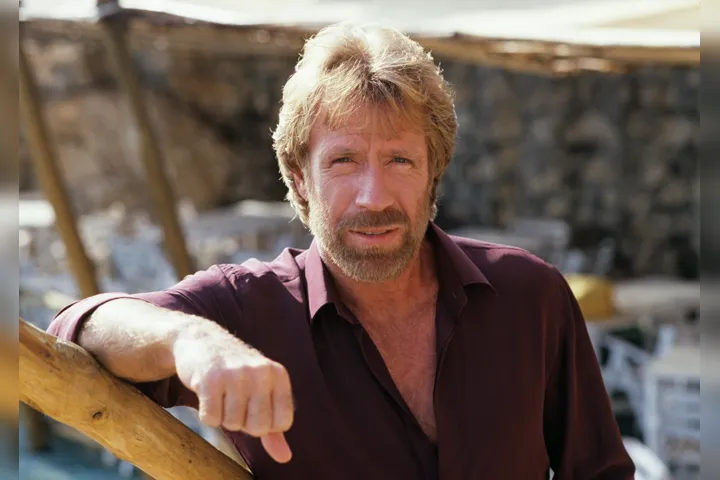
Chuck Norris, ‘Walker, Texas Ranger’ Star and Champion Martial Artist, Dead at 86


Click here to read the full article.
Chuck Norris, the martial arts champion who became an emblematic Eighties action star, died on Thursday. He was 86.
Norris’ family confirmed his death on Instagram Friday morning after reports emerged that Norris had been hospitalized in Hawaii earlier this week after an unspecified medical emergency. No cause of death was given, with the family saying they “would like to keep the circumstances private.” But they added, “please know that he was surrounded by his family and was at peace.”
The family’s statement continued: “To the world, he was a martial artist, actor, and a symbol of strength. To us, he was a devoted husband, a loving father and grandfather, an incredible brother, and the heart of our family. He lived his life with faith, purpose, and an unwavering commitment to the people he loved. Through his work, discipline, and kindness, he inspired millions around the world and left a lasting impact on so many lives.
“While our hearts are broken, we are deeply grateful for the life he lived and for the unforgettable moments we were blessed to share with him. The love and support he received from fans around the world meant so much to him, and our family is truly thankful for it. To him, you were not just fans, you were his friends.”
Norris was one of the busiest action stars of the 1970s and Eighties, popping up in a mix of big studio flicks and independent martial arts pictures. His 1983 film, Lone Wolf McQuade, in which Norris played a Marine-turned-Texas Ranger, went on to inspire his hit TV show, Walker, Texas Ranger, which enjoyed a nine-season, 203-episode run on CBS during the Nineties and early 2000s.
Cut from the same mold as John Wayne and Clint Eastwood before him, Norris gravitated toward playing strong, silent types. Long before he played the archetypal, ultra-masculine modern cowboy on Walker, Texas Ranger, Norris exuded the quiet strength and discipline that he’d learned from practicing martial arts. Onscreen and off, he maintained a stoic countenance, a perfect poker face that never hinted at his next move. When The New York Times profiled Norris in 1985, it introduced him by saying the interview found him doing two things he didn’t do much of onscreen: smiling and talking.
Growing up in Ryan, Oklahoma, where he was born Carlos Ray Norris on March 10, 1940, to a Cherokee father and an Irish-English mother, Norris would recount that he saw Wayne’s characters as sort of a “substitute father.” His dad, an alcoholic, left the family when Norris was 10. His parents divorced in 1956. The remainder of the Norrises (Chuck had two younger brothers, Wieland and Aaron) later relocated to Torrance, California.
“I was shy, unathletic and only a C student,” Norris told The New York Times in 1993. “I did make the football team, but I was second string. The coach wanted those aggressive types. I just wasn’t one of them.” He had low self-esteem as a child fueled by racist taunts of “half-breed,” he said, adding that he dreamt of being strong enough to fight back.
Although he seemed born into martial arts, Norris didn’t begin studying until he joined up with the Air Force, serving in South Korea. He took up karate, he told the Times, to better serve him when he returned home to the U.S., where he hoped to become a policeman. But he found himself so enamored with martial arts that he instead opened a chain of karate schools throughout southern California, where he also honed his own talent to become the world middleweight karate champion from 1968 to 1974.
It was the right time and the right place, since kung-fu movies were beginning a boom thanks in part to Fists of Fury a.k.a. The Big Boss, a 1971 movie starring Bruce Lee. At the suggestion of actor Steve McQueen and his son Chad (one of Norris’ karate students), Norris decided to try acting. He made his film debut playing a bit role in The Wrecking Crew, a 1968 Dean Martin vehicle, for which Lee had served as action choreographer.
Lee and Norris later starred opposite each other in Return of the Dragon, a.k.a. The Way of the Dragon, released widely in 1973. A showdown between the two actors in Rome’s Colosseum catapulted Norris into the spotlight. “I’d never been in a movie, and I [was] intimidated,” Norris recalled in author Nick de Semlyen’s book, The Last Action Heroes. “So I started eating pasta. Then I stopped working out for almost a month. I went from 167 pounds to 185, and that’s why you don’t see me doing any jump-kicks in the movie. I didn’t think I could get off the ground.” Nevertheless, Norris cut a striking figure, and the role set him up for an long-lasting acting career, though it seemed to peter out at first.
A string of movies throughout the Seventies in which Norris acted and occasionally served as fight choreographer, such as Breaker! Breaker! (1977) and Good Guys Wear Black (1978), experienced only middling success, and the dismissal of critics irked Norris. When he hit his stride again in his mid-forties with Missing in Action (1984) and Code of Silence (1985), he appreciated what he considered long overdue acclaim.
”I’ve worked hard these last nine years to get critics to look at me in a different light,” he told the Times in 1985. “They’re usually more concerned with things like Passage to India, and they’ve hit me hard all these years, especially in the beginning.”
Around this time, Norris also tried his hands at writing, coauthoring the script to Invasion U.S.A. (1985), in which he also starred. He got the idea for the film after a Reader’s Digest article suggested that hundreds of terrorists were plotting against the United States. “I thought, ‘Boy, that’s scary,'” he told the Times. “‘What if some guy on the order of a Khomeini or a Qaddafi mobilized those guys and started sending them out to every major city?'” So in the movie, terrorists begin blowing up shopping malls and tract homes, “all the places where working people go,” Norris explained at the time. He’d later return to the terrorism well with The Delta Force, a massive success in 1986.
Offscreen, Norris championed conservative politics, especially in later years. In 2008, he recorded a 30-second ad spot supporting the National Rifle Association. “Hi, I’m Chuck Norris, a black-belt patriot,” he said. “If some thug breaks into my home, I can use my roundhouse kick, but I’d prefer he’d look down the barrel of my gun.” Four years later, he contended that if Obama were reelected, “our country as we know it may be lost forever.” In 2015, Norris stumped for Mike Huckabee, when the former Arkansas governor was running against Donald Trump for the Republican presidential nomination.
Throughout the Eighties, Norris appeared in sequels to The Delta Force and Missing in Action before his career stumbled again in the Nineties. Although 1992’s Sidekicks, a comedy-drama in which he played himself opposite Jonathan Brandis, was a hit, the public appetite for his sort of action movie waned. In 1995, he starred in Top Dog, one of many “cop with a dog” movies from the era, and it failed to recoup the budget. Many of his movies were released direct to video.
Norris’ saving grace during the era was Walker, Texas Ranger, the melodramatic crime series that premiered on CBS in April 1993 and ran eight seasons until concluding with a cliffhanger, never to be resolved, in May 2001. Norris played Sergeant Cordell Walker, a Texas Ranger raised by his uncle, a Native American named Ray Firewalker, notable since his dad was named Ray and in ’86, Norris had starred in Firewalker. With his partner, James Trivette (actor Clarence Gilyard Jr.), Walker fought crime in and around Dallas each week. Norris sang the show’s theme music. Although it was never a runaway hit, the series garnered a reliable viewership in Nielsen’s Top 20 throughout the Nineties.
Norris returned to movies in the 2000s, making a memorable cameo as himself in Dodgeball: A True Underdog Story (2004) and for joining the cast of The Expendables 2 (2012), a sequel to Sylvester Stallone’s successful vehicle for once-popular action stars including Arnold Schwarzenegger, Jean-Claude Van Damme, and himself.
His genuine martial arts talents, mixed with the imposing, no-nonsense attitude of his characters also famously made Norris perfect fodder for an early internet meme. “Chuck Norris facts” centered on comically hyperbolic examples of the actor’s exploits like, “Chuck Norris doesn’t flush toilets; he scares the shit out of them”; or “Chuck Norris has a grizzly bear rug in his bedroom. It’s not dead. It’s just too scared to move.” Norris embraced the memes, and even made appearances on Late Night With Conan O’Brien (which had long-tapped Walker, Texas Ranger as a font for jokes) where he read out the facts and took part in sketches. By 2011, he was able to transmute irony into a salary appearing in laundry “Chuck Norris approved” detergent ads and, later, Mountain Dew. He also endorsed the gun company Glock.
Outside of acting, Norris authored many books (including the nonfiction Black Belt Patriotism: How to Reawaken America, which offered his views on conservatism, in 2008) co-founded two philanthropic organizations. The United Fighting Arts Federation, launched in 1979, aimed to connect Norris’ karate with krav maga, and Brazilian jiu-jitsu via tournaments. Another, Kickstart Kids, founded in 1990, which “teaches character through karate” to middle and high school students, according to its website.
Norris married his first wife, Dianne Holechek, in 1958. The couple had two sons, Mike and Eric. Norris fathered a daughter, Dina, born in 1962, outside of his marriage. Norris and Dianne divorced in 1989, and Norris married his second wife, Gena O’Kelley in 1998. The had fraternal twins, Dakota and Danilee, born in 2001.
“All I wanted to do in movies was be a positive image,” Norris said in the ’93 Times interview. “I wanted to be likable, as I do in real life. I don’t like violence for violence’s sake. … In my movies, I never attack anyone. I don’t cause trouble, but I end it.”
This story is developing.